Tuesday, November 9, 2010

Let's Talk About Fair Trade, Baby!


Fair Trade is, fundamentally, a response to the failure of conventional trade to deliver sustainable livelihoods and development opportunities to people in the poorest countries of the world. Poverty and hardship limit people's choices while market forces tend to further marginalise and exclude them. This makes them vulnerable to exploitation.

Fair Trade. It sounds wonderful, those two little words that mean so much to many people around the world. Beginning in the 1940s and 50s, fair trade took awhile to get a hold of people's attention. Dealing in mostly handicrafts, fair trade become somewhat of a fad which many people viewed as more of a student political movement. In the 1960s and 70s, the Fair Trade movement looked for various products to sell, but it wasn't until the 1980s that the movement started turning it's focus to agriculture. Finally, in the 1990s, a labeling initiative was born which allowed for the products to be sold in more stores and it allowed for distributers to track the origin of their product and see if this new type of trade was helping those at the beginning of the line (the producers, farmers, workers).

Like buying organic or buying locally, fair trade is not just about the product you receive, but how it benefits those who produce it. It's a label that allows consumers to know they are buying a product that is environmentally friendly, gives the producers of said product a fair wage and better living conditions, and that has an important and direct impact for the better on those who produced it and the community in which they live and work.

As far as flowers are concerned, buying Fair Trade flowers contributes to the well-being of flower workers around the world and the community they live in. Not only are workers paid higher wages, but a portion of every purchase goes directly into a community development fund that the community decides what to do with (i.e. scholarships, housing, loans, etc). In terms of the environment, buying Fair Trade certified flowers increses the use of natural pest controls (instead of harmful chemicals) and reducing water and energy use. This, by extension, increases the quality of the products.

Where can you find Fair Trade flowers? Whole Foods sells them with their Whole Trade seal which guarantees that their floral products are grown according to strict criteria for ethical trade and earth-friendly farming.


Tuesday, September 21, 2010

Peter, Peter, Pumpkin Eater: Pumpkins, Pumpkins, Everywhere!


pumpkin knitting is fun!
In honor of autumn, I have dedicated this blog post to the lovely, versatile, amazing pumpkin. There aren't many things that can be used for food and decorations, but pumpkins (along with other squash) can be both. Pumpkins have been around for quite awhile, with the earliest known seeds dating back between 7000-5500 BC, which were found in Mexico (Thanks, Wikipedia). Pumpkins can be grown on every continent except Antarctica, with the U.S., Mexico, India, and China being the largest producers. In the U.S. alone, 1.5 billion pounds of pumpkins are produced every year, of which 95% are grown in Illinois. The other 5% of pumpkin-producing states include Indiana (yay!), Ohio, Pennsylvania, and California.

pumpkin pie

Pumpkin is an extremely versatile food. It can be sweet or savory, put into a Thanksgiving classic like pumpkin pie, or whipped into a creamy pumpkin soup. Almost everything about a pumpkin is edible, including the shell, leaves, and flowers. It is definitely a staple food at many autumn gatherings, and if you're lucky, hopefully you'll be able to sample more dishes other than pumpkin pie (like pumpkin cookies, yum). Of course, pumpkins are also carved every year at Halloween, something many people look forward to, including myself. Last year I went for a large open-mouth motif (think: scream). It was a little creepy at night.

party in my pumpkin

Autumn, my favorite season, the season of all seasons, makes Ben White Forist happy (and me, too). Last year, we invented a lovely arrangement in a ceramic pumpkin container, and it was quite a hit (pictured right, Party in My Pumpkin). Well, the ceramic pumkins arrived today, packaged in bubble wrap, anxiously awaiting their new homes and ready for you, our beloved customer, to purchase. Not only do they look lovely in your home beautifully arranged with flowers, but once cleaned out, they become amazing candy dishes (or whatever your heart desires).

Wednesday, August 18, 2010

Going Green Burials

Death. We don't want to talk about it, but it's a natural part of everyone's cycle on earth. In modern U.S. society (generally in the last 100 years), the dead are embalmbed with carcinogenic chemicals, placed in a casket made of rainforest wood, and then buried in the earth, left to slowly decompose and release toxic chemicals back into the soil and groundwater. This is all done for the sake of family or friends who seem to need that last "mental picture" of their loved one. A mental picture of a loved one stuffed with chemicals and painted with makeup to look "natural." A mental picture that costs upwards of $10,000. In the end, is it really worth it?

Green burials are the alternative choice. Before embalming chemicals were invented in the mid 19th century, green burials were the norm, except of course they were just called burials without the need for the green adjective. When one died, they were wrapped in a shroud or placed in a simple wooden box and buried in the ground, their bodies left to return to the earth, naturally. Green burials simply acknowledge that the end of life is decomposition and decay.
Contemporary embalming methods came to be practiced more often after the American Civial War. Dr. Thomas Holmes was commissioned by the army to embalm the corpses of officers to return home to their families. Then, in 1867, the German chemist August Wilhelm von Hoffman discovered formaldehyde, which became the foundation for modern methods of embalming. The following is an excerpt from a Wikipedia article about the emabalming of a corpse, which thorougly reveals how quite unnatural the process is:

The corpse is washed in disinfectant and germicidal solutions...The embalmber bends, flexes, and massages the arms and legs to relieve rigor mortis. The eyes are posed using an eye cap that keeps them shut and in the proper expression. The mouth may be closed via suturing with a needle and ligature, using an adhesive, or by setting a wire into the maxilla and mandible with a needle injector...Care is taken to make the expression look as relaxed and natural as possible ("Embalming").

Going green: Being aware of the environment, and as humans, being aware of ourselves within a larger ecosystem and our existence that tends to be harmful on the earth. Several chemicals are found in an embalmed corpse including formaldehyde (a class 1 carcinogen), glutaraldehyde, phenol, methanol, antibiotics, dyes, preservatives, additives, disinfectants, and sanitizing agents, which are all pumped into the corpse via the blood vessels. As the body decomposes, the chemicals leak into the soil. Coffins used to bury the deceased are generally made from more expensive wood that is transported from far away and covered in non-biodegradable laquers.

So, who wants to have a green burial? I do. In the U.S., there are no laws stating that a body has to embalmed. Generally, a green burial costs thousands less than a traditional funeral and it is also more intimate for the family. Imagine having your funeral service in a forest of your native state, surrounded  by the sounds of nature. Each state has different regulations, but in general, a body cannot be embalmed to be buried in a natural burial ground or nature preserve. Usually, the land is kept in an untouched state where the bodies can be returned to nature. The coffins are made of local lumber or the deceased is wrapped in a shroud, and instead of a headstone, an indigenous rock or a tree planted by the family is preferred. In terms of floral arrangements, vases, containers, oasis, and wires are not accepted at a green burial as they do not decompose. However, loose flowers (tied with rafia as needed, a biodegradeable grass) are preferred. At Ben White Florist, we are happy to offer alternatives for green burials other than the traditional funeral flowers, including a wide variety of loose flowers that we can tie with rafia if needed. Looking toward the future, green burials are definitely an option to be considered for yourself, your family, and for the earth.


Yahoo! News Article 14 October 2010 More Americans choosing natural burials

Tuesday, June 29, 2010

We Want to Win!

Each year, The Austin Chronicle (Austin's free, weekly newspaper: The Austin Chronicle) reveals its "Best of [enter year here]" results as voted by readers, consumers, locals, and crazies alike. In 2008, we won Best Florist in Austin. It was unexpected and great. It meant  a lot to us being voted as a fan favorite even though we weren't trying for it. This year, we are trying. Begging, if you will. We want to win again.

Why should you care if we win Best Florist? What does this mean for you? Just think about it. Think about how cool it would be to shop in your favorite local flower shop that has been recognized by fellow Austinites as being the best in Austin. Cool, huh? Yes. Absolutely freaking awesome! Plus, we can add another banner to the outside of our shop so everyone who drives by will see our winning trophy of accomplishment.

Voting is so simple, you'll want to do it again and again, (but you can't, since they only allow one vote per person). Just go here: click me to vote! and under "Services" find "Florist" and vote for us! Please and thank you. If you enjoy voting for your favorite florist, then you might find it fun to continue voting for other things, such as favorite bathroom, movie theater, weatherpeson, scandal, and much more! It's so much fun filing in the blanks, I almost voted for Jim Spencer twice (my favorite weatherperson)! Have fun voting, and know that we truly do appreciate it.

Tuesday, June 22, 2010

Hail the Conquering Dutch! Part 2: In Love with the Modern World

While the Dutch East and West India Companies may no longer be around, the reign of the Dutch in the flower market still persists. Currently, Holland is still the titan of tulip production with an annual worth of one billion dollars (Stewart 109). Geographically, Holland is located barely above sea level. In order to allow more room for growing tulips, the Dutch drained lakes and built construction canals, expanding the acreage of agricultural land to more than 50,000 acres. The bulb fields bring in more than 1.5 million tourists a year and Holland occupies more than 65% of the world market in the production of tulip bulbs.

Gerbera daisies are also a very popular flower among florists and growers alike. Native to Africa, Asia, and South America, it is the fourth most popular flower sold at the Dutch market and Americans alone buy over 200 million stems a year. Gerbera daisies established themselves in the floral business during the 1980s when bright colors and clean, modern shapes were fashionable and they still continue to be very popular. Terra Nigra, a company based in the Netherlands, has been breeding gerberas and roses for over 40 years (Terra Nigra). With the variety of color options available, it's no wonder why many people, consumers, florists, and growers alike, fall in love with the happy gerbera.

Not only do tulips and gerberas account for much of what is sold on the Dutch market, but roses also have a hefty stake in the flower market. Roses alone account for over $700 million worth of trade, double the amount that is spent on the number two bestseller, chrysanthemums. The U.S. alone makes up about half of the worldwide demand for roses by buying about 1.5 millions stems a year. Native to China, northern Europe, and the United States, a true wild rose has five petals and grows only in shades of red or pink. However, a florist rose (one that has been bred) appears to have many petals in a wide variety of colors. In reality, it too has just five true petals with the rest of the petals being modified stamens (though one couldn't tell the difference of petals by looking). The hybridizing of roses began in 18th century Europe and eventually, floral designers were given an engineered rose with a higher petal count and a longer vase life, as opposed to a fragrant smelling, five-petaled wildflower that one probably wouldn't even recognize as a true rose.

For centuries, it [the rose] was something beautiful and romantic and wild. Eventually, in our own crude way, we started to cultivate it, selecting for the brightest color and the most elegant shape, figuring out how to grow it indoors and make it bloom in winter. But now, just in this last century, roses have become science experiments, lab rats. Now the perfect rose is one that can live in a factory and be fed by a machine. It is built to suit the needs of the grower, not the lover. Does that change anything...Does it kill romance? (Stewart 133).

Stewart, Amy. Flower Confidential: The Good, the Bad, and the Beautiful in the Business of Flowers. Chapel Hill: Algonquin Books, 2007.

Tuesday, June 15, 2010

Hail the Conquering Dutch! Part 1: Tulipmania

It seems only natural that when one thinks of flowers, ultimately, one must consider the Dutch. The Dutch East (and West) India Company dominated the world trade business in spices, fur, sugar, and coffee during the 17th and 18th centuries. Reaching out into the continent of Asia for colonization purposes, the company also extended themselves into the world of flowers, creating a market for flowers where one did not exist (at least in Europe). Most would consider the tulip the most well-known bulb that the Dutch have cultivated. It is widly believed that in 1593, a botanist by the name of Carolus Clusius arrived in Holland with bulbs of an unknown wildflower from Turkey and Persia: the tulip (Stewart 106).

Clusius began cataloguing tulips by color, bloom, size, and quickly tulips became all the rage in Holland, the most desired flower among gardeners and growers alike. Not only were they much desired, tulips would sometimes "break," (resulting from a virus which was not realized until the 19th century), which meant they might form stripes or produce feather tips. Because no one had anyway of knowing which bulbs would break, they were purchased for extremely high prices, escalating phenomenly in the 17th century, creating the frenzy we know today as tulipmania. At auction, tulip merchants would continually outbid one another, knowing they could simply sell their bulbs the next day for a higher price. A single-priced tulip bulb could sell at auction for the price of a Dutch canal house. In 1637, the tulip market crashed at the Dutch auction, with tulips becoming worth less than 5% of their original price, culminating in widespread bankruptcies for anyone who had invested (Stewart 109). After tulipmania, the price of one bulb decreased from about 1,250 gilders to a much more reasonable 1 gilder, allowing the Dutch to continue dominating the flower market with their tulips.

*Field tulips from Holland are available late January- early-May of each year.

Stewart, Amy. Flower Confidential: The Good, the Bad, and the Beautiful in the Business of Flowers. Chapel Hill: Algonquin Books, 2007.

Tuesday, June 8, 2010

Summertime Texas Flowers: Buy Local!

As a a small independent business located in Austin, TX, we understand that our customers enjoy buying locally. Not only do they enjoy the thrill of a local blossom, but they will specifically look for what's local, which means finding certain stores that carry their locally-wanted product. It's always nice to know where your products come from, so in the spirit of this new earth-movement of grow local; buy local, I would like to tell you where our locally-grown flowers are born. (Keep in mind, not all of our flowers are grown locally, but from March-Novemeber each year, we carry a wide variety of Texas blooms).

Texas Specialty Cuts: Arnosky Family Farm
Located in Blanco, TX, this wonderful family farm has been operating since 1990 in the Texas Hill Country. Not only do they grow a wide variety of beautiful flowers, they also grow vegetables, heirloom and specialty vegetable plants, hardy Texas annual and perennial plants, and they even make artisan cheese. Owned by Pamela and Frank Arnosky, the farm is located on 130 acres with a field season in operation from March-November and greenhouse production all winter long. Their flowers range from natural Texas flowers such as coreopsis and black-eyed susans, to elegant flowers such as oriental lilies and calla lilies.

Concerned with organic growing practices and sustainable farming, the Arnoskys use organic compost, a complex, living soil that improves plant growth, retains soil moisture, improves soil structure, and helps prevent topsoil erosion. They also allow their uncultivated areas to grow naturally, allowing it to be a habitat for beneficial plants, insects, and animals. It is important to know who grows your food, plants, or anything for that matter, and small family farms are an integral part of local sustainable farming. Buying from a locally-owned family farm helps Ben White Florist further cultivate and participate in local sustainability.

During this time of year (early summer), when you come by the shop, expect to see beautiful sunflowers, asiatic lilies, snapdragons, delphinium, zinnias, coreospsis, rudbeckia, yarrow, queen anne's lace, gerbera daisies, mini gerbera daisies, and much more!


Tuesday, March 23, 2010

forget the alphas, bring on the tulips!

In an effort to understand how flowers are grown for the commercial flower industry, I came across a few paragraphs in Amy Stewart's Flower Confidential. They read almost like something out of Brave New World, but instead of Alphas and Deltas, we have tulips and lilies. I'm including a few paragraphs here to give one a better idea into what large-scale commercial greenhouse-growing is like:

For the most part, they don't even have to bother putting roots down into the earth. Tulips and lilies are tucked into their plastic crates, and gerberas live quite contentedly in plastic pots that contain no dirt at all, just shredded coconut fiber that acts as a clean, disease-free conduit for water and fertilizer. [...] The lighting is perfect, and if it's not, a battery of equipment and a trained staff are there to take care of it [...].

Water and food move through tiny plastic drip lines that resemble IV tubing, and if something about the meal is not quite right, it is not incumbent upon the flower to complain. The staff measure the fertizilizer left in the water that runs out the other end of the drip system; if there is too much of a particular nutrient left the plants might have been overfed and unable to take up any more, and if there is too little they might have grabbed all they could and still felt hungry at the end of their meal. Either way, it's all adjusted right away, before the plant shows the first sign of stress. They're even groomed to perfection. Smaller buds are carefully snipped off to encourage larger blossoms, and any leaf that is blocking light to the rest of the plant or showing signs of fatigue is quickly removed. A leaf's duty is to support the flower, not sap its strength. If it isn't doing an efficient enough job of capturing light to transform it into energy for the plant, it's got to go.

There are some drawbacks to this sheltered lifestyle. Greenhouse flowers might miss the company of bees, for instance. They don't get pollinated, because they aren't expected to reproduce and they've been bred to produce huge flowers without it. Even if a bee did sneak in and make a move, it would probably be pointless--breeders often make flowers sterile as a little extra protection for the patent. Greenhouse flowers won't feel the rain showering down on their leaves as overhead watering encourages disease and droplets of water on a leaf can intensify the sun's rays, leading to a scorch. Even the wind won't shake their stems unless, of course, a good stiff breeze is needed to cool of the greenhouse, to keep gases like ethylene from stagnating, or simply to toughen up the flowers and make their stems stronger so they'll stand up straighter in the vase. In that case, the fans come on and blow an artificial wind along the rows of flowers.

As comfortable as their time in the greenhouse might be, it also goes by dizzyingly fast. A tulip can shoot up and bloom in three weeks. An Asiatic lily might take only nine weeks. Gerberas are expected to produce one or two perfect blooms every month. And when their time is up, each flower is picked individually by the same person who has cared for the plant, day in and day out, for weeks or months (Stewart 93-94).

Stewart, Amy. Flower Confidential: The Good, the Bad, and the Beautiful in the Business of Flowers. Chapel Hill: Algonquin Books of Chapel Hill, 2007.

Thursday, March 18, 2010

Who said anything about violets, Violet?

Violets are funny little things. Presently, they cannot readily be found in many flower shops, unless of course one shops near where they are grown, which is pretty much only in the Pacific states. A century ago, however, violets were one of the most popular cut flowers, ranking just behind roses, carnations, and chrysanthemums. Viola odorata is a short-lived flower, lasting at most four days from when it is picked, but it's sweet scent enhanced it's popularity during the Victorian era (Stewart 62). Currently there are over 500 species including unscented violas and pansies, which can be found in many gardens across the country.

In the early 1890s, Rhinebeck, New York was the violet capital of the world. Violets were easy to grow in the winter, but somewhat tricky to harvest in the spring. Workers would often have to lay atop wooden planks so not to damage the violet's delicate blooms. At a time when a florist was defined as a person who both grew and sold flowers, violets were easy to come by if one lived near a farm outside the city where they were grown. From the 1890s until WWI, Rhinebeck produced 35 million bloosoms a year, while a bunch sold for less than a dollar. With such a powerful and enjoyable scent, violets came to be used for perfumes and even breath fresheners for Victorian women (Stewart 63).

Around the same time that Rhinebeck was becoming the world's violet capital, Dominik Garibaldi was coming into his own in California. Travelling to California in in the early 1900s, Garibaldi settled in the San Mateo valley just south of San Francisco (Robinson). With it's well-drained sandy soil, cool ocean breezes, and seasonal winter rains from the Pacific, the area was perfect for violet-growing. The Garibaldi violet farm is one of the last violet farms in the country and probably the most well-known. They produce about 15,000 bunches per year with 25-35 blossoms per bunch (Stewart 70).

Violet fun facts:

  • Napoleon Bonaparte's wife, Josephine, loved violets and wore them on their wedding day. Napoleon adopted them as part of his campaign when he was banished from the country, encouraging his followers to wear them while proclaiming that he would "return with the violets in the spring" (Albert).
  • Violets have been used for centuries as an herbal remedy for sore throats, as a sleep aid, and against inflammations. Later, it was discovered that violets contained a soothing mucilage that was laced with a salicylic acid, a precurser of asprin (Albert).
  • "Unlike most other florists' flowers, they [violets] have not been improved upon, genetically modified, or coaxed into growing taller or living longer. There as been no perfume thrown on [...] violets" (Stewart 66).

Tuesday, February 2, 2010

the quest for the blue rose...

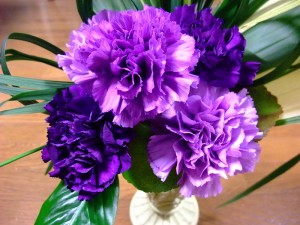
Traditionally, blue roses have been an imaginative beauty, a uniquely-colored rose that cannot be found in the natural world. Always mysterious as the Victorians suggested, a true, blue rose has never existed and perhaps that's why they also represent a never-ending quest for the impossible. Florigene, the Australian-based company who gave customers the Florigene Moonseries carnations in a lovely array of purples and mauves, has been trying to develop a blue rose for years (Stewart 41). Because roses lack delphindin, the pigment that produces blue petal colors, they cannot exist naturally. However, they can be genetically modified, which is what Florigene has been trying to accomplish for the past 26 years.

In 1986, Calgene Pacific Pty Ltd. was founded in Melbourne, Australia, changing its name to Florigene in 1994 after aquiring assests of the namesake competitor in Holland ("Florigene"). As stated on Florigene's website, Florgene "uses genetic modifcation technology to bridge genetic gaps and rapidly deliver valuable improvements to flower species. The improvements to flowers, whether in shape, colour, vase life, disease resistance or other characteristics-have historically been achieved by cross-breeding existing varieties." They are, in fact, the world's first molecular breeder of flowers. One of the original missions of the company was to create the first blue rose through genetic modification. Suntory Limited, a Japanese partner company of Florigene, successfully isolated the blue gene from a petunia flower in 1991. Florigene became primarily interested in implanting the blue gene into flowers that lack it: roses, carnations, gerbera daisies, and chrysanthamums ("Florigene"). Florigene was first successful in implimenting the blue gene into carnations, thus developing the first transgenic flowers for sale: the "Moonseries" carnations (Stewart 41).

In 2004, Florigene announced the development of a "novel color" rose in the blue scheme, and has since developed one. Although it has been described as more lilac in color, Florigene's website has stated a "novel color" rose is scheduled for marketing in 2-3 years, but so far, it seems as if the color scheme may be more closely related to the "Moonseries" carnations of mauves and purples.

For more information on Florigene, please visit their website at www.florigene.com.

Sunday, January 24, 2010

stop acting like a flower.

They do all this for flowers. Airplanes fly in from Bogotá and trucks drive from Miami and acres of greenhouses get built and billions of dollars change hands. All that for the alstroemerias you pick up at the grocery store as an afterthought. [...] The cut flower trade is all about this struggle between what is natural and unspoiled and what is mass produced and commercialized.
-
Amy Stewart, Flower Confidential: The Good, the Bad, and the Beautiful in the Business of Flowers

Products are easily accessible. A customer simply has to walk, bike, or drive to a store and purchase whatever their heart desires. The same is true with flowers. Walk into any grocery store or flower shop and one may find a vast array of flowers that magically happen to be there despite the fact that many of them are not in season (in terms of fresh produce, think about fruits and vegetables). Tulips in fall, sunflowers in winter, roses all year round. Most florists do not have acres of flowers growing in their backyard just like one won't find a farm behind a favorite grocery store. Flowers are a global business, trucked and flown in from around the world so the consumer can have whatever flower they want whenever they need it. "Orchids from Thailand. Tulips from Holland. Lilies from Colombia. Ginger blossoms from Hawaii" (Stewart, 4).

Unlike food, flowers have no nutritional value. Unlike art, their beauty does not last. Despite this, Americans purchase more than 4 billion flowers a year (4). The business of buying and selling flowers is nothing new, in fact, it is most likely one of the oldest businesses in the world, dating back thousands of years. So why do we pay for something we could get for free? Flowers are one of the best forms of a mood stabilizer without interacting with one's chemical messengers inside the brain. Purely visual, sometimes sensual, they have a certain cheerfulness about them that can't quite be replaced by anything else, except perhaps, more flowers or a foray into nature.


The supreme irony of cut flower breeding lies in the fact that we use all of the science and technology available to us to make a flower stop acting like a flower (Stewart, 21).

In terms of lilies, there are three main types: trumpet lilies, Asiatic hybrids, and Oriental hybrids. For years, breeders were obsessed with trying to find a way to combine the upward-facing characteristic of the Asiatics with the the bold and fragrant-producing Orientals (20). This became possible by a man named Leslie Woodriff. Somewhat of a mad-scientist, Woodriff was obsessed with lily breeding, not necessarily to monopolize on the fortune of creating new breeds, but because he was consumed with the art of lily creation. Woodriff would cross-breed in the simplest of manners: dusting pollen from one lily onto the stigma of another. Now, most hybridizers are geneticists, not plant enthusiasts like Woodriff. While he probably created hundreds of new lily breeds, he barely labeled his work and some of his breeds were lost in a complicated dispute with Sun Valley Farms (30).

Woodriff created the stargazer in the late 70s and both he and Sun Valley Farms barely made anything off this new creation, even though it is one of the most popular selling lilies ever. The Dutch, however, bought the patent to sell the stargazer in Holland and made a fortune. Without Woodriff, the stargazer lily would probably not exist. Now one of the most popular lilies around, it can be found in virtually every flower shop across the country, if not the world. Its upward-facing blooms and bright color make it a must-have for any florist.

*Woodriff also created "Black Beauty," a dark red lily edged in silver, and "White Henryi," a white lily with a butterscotch blush and cinnamon-colored freckles (37).

Wednesday, January 20, 2010

tiptoe through the tulips...

First of all, I hope everyone had an enjoyable holiday season. We were quite busy at Ben White Florist, stumbling around the shop trying to make our way through all of the poinsettias, while also trying to have functional respiratory systems amidst all of the cedar, pine, and lovely (and allergy-inducing) winter greens. Despite the allergies, the holiday season was quite lovely.

Now, on to the present: the tulips have finally arrived! Each year, we anxiously wait for these delectable Holland treats, biting our nails in anticipation of their glorious and somewhat celestial arrival. For a measly $10, you, our dear and devoted customer, can have an entire bunch of these gorgeous ladies to enjoy in your very own home. Why not bring a piece of history home with you? Interesting factoid: Tulips were responsible for the very first economic speculative bubble, their price being 10 times more expensive than a skilled craftsman's yearly salary (Thank you, Wikipedia). So, be a part of tulip mania and pretend like you are living during the 17th century Dutch Golden Age. Treat yourself to some royal flowers. Plus, since tulips aren't really associated with the winter, fool yourself into thinking it's spring! I swear, once you have a vase full of tulips in your house, you'll never be unhappy again.